
Driving & Travel in Iceland in the Winter
I was a little anxious driving in Iceland because I really didn't know what to expect. I didn't know how bad the roads would be, how the weather might affect our travels, or what Icelandic drivers would be like. I was also nervous about driving this new van around for 2 weeks! I scoured the internet looking for information about driving the Ring Road during winter, campsites, fuel stations, and itinerary. I found decent information, but I never found exactly what I was looking for to calm my nerves. So this post is all of the answers to the questions I had before our trip!
It was really much easier than I could have imagined. Once we figured out road signs, general place names, and the rotation of checking weather/volcanic gas predictions/the roads websites/the wind forecast, we were good to go!
Our Vehicle
We rented a van from Happy Campers, and their office is right outside of downtown Reykjavik. Jon, the owner of the company, picked us up from the airport. He took us straight to the Happy Campers office where we finalized our rental. Along with our van, a 5-speed Ford Transit Connect (they only have manual transmission!), we put a second driver on our rental (in case Justin would be driving, as well), rented sleeping bags, rented an inverter (for charging phones and camera), and "shopped" at their "store" - they have shelves with leftovers from other travelers (spices, paper towels, nonperishable foods) that you may take for free. We headed on our way once we had our gear packed into our van. We named her Isa. 🙂

our camper van rental
The van was great. It was so great to have freedom to not worry about tour buses, our schedule was flexible since it was just us, and we could go wherever we wanted. One major tip - make sure to pack with collapsible luggage! The luggage we used was the typical stiff-sided luggage. It would have been so helpful for it to collapse down (like a duffel bag) since we had so little space. We were constantly moving it around since it was in the way.
Justin (being 6 ft tall) was a little cramped on the bed, but 5 ft 3 in me was fine! The space is obviously small, but it worked for our trip. The van had a bench seat in the back that folded out into a bed, and it had storage beneath it. We had a small cooler, a sink with running water, and a small portable burner. Kitchen essentials - pots, pans, plates, silverware, cups, cooking utensils - were all provided, along with environmentally-friendly soap. The sink drained straight down to the ground. The solar panel on the roof provided power for the cooler, the sink, and the Webasto heating system. Since the heating system would kick over to the main battery once it ran out of power stored from the solar panel, we could not keep the heat on overnight (else we'd kill the main battery and would have a major problem!). We would leave the heating system for the hour before we went to bed. We turned it off when we went to sleep, and we slept with sweatpants, hoodie, socks, t-shirt, a quilt, a comforter, a fleece blanket, and 1 sleeping bag for each of us. When snuggled up in all of that, we were very warm! Once the alarm went off in the morning, I would either turn on the heating system or just turn on the van to thaw everything out. It was manageable!
Mobile Wifi from Trawire
First of all, the best decision we made for trip prep was deciding to rent a mobile wifi. I had read a bit about Trawire's mobile wifi options in a blog of someone's Iceland travels and thought we should give it a shot. And at $10/day for our two weeks in Iceland, it was absolutely worth it! This little unit (about the size of a TomTom GPS) allowed us to have unlimited internet connection (while in range, which was virtually everywhere we were) for GPS (we used Google maps on our iPhones), posting blog updates, checking email, posting to Facebook, and researching trip information. It was a lifesaver and such a great addition since we could keep in contact with everyone in real time. Every once in awhile we would get spotty reception (especially between Mývatn and Egilsstaðir), but it was never long enough for us to get worried. Plus, the Ring Road is one giant loop, so it's hard to get lost!
Dealing with the company Trawire itself was...interesting. We were very happy with the service and the price, but it was not easy at all to contact the company. We scheduled to pick it up during a time when the office wasn't open (Saturday), but they arranged to have it sitting on top of the mailboxes in the atrium of their office building. That was easy. Dropping it off however? No one was in their office. None of the other companies located on the same floor knew where they were. We finally called a number I found for them on their Facebook (the phone number on their website was disconnected), and the man told me to just leave the unit on the mailboxes where we picked it up initially. So overall, I wasn't completely stoked about their customer service, but I know that they were in the middle of moving their offices. So let's give them the benefit of the doubt. The mobile wifi (that we lovingly called Mwifi) itself? Absolutely superb.
The Ring Road
Route 1, also commonly known as the Ring Road, Þjóðvegur 1 or Hringvegur, is the main road that circles nearly the entire country at a total length of 830 mi or 1,332 km. For the most part, the Ring Road stays along the coast, as this is where the majority of the population lives. The coast also typically sees less snow than the highlands (the central part of the country) or the Westfjords (the large northwest peninsula). The Ring Road is mostly a 2-lane highway, though it does grow to four lanes when driving near Reykjavik. Icelanders drive on the right side of the road, same as the U.S. The vast majority of the Ring Road is paved, but there are portions that are gravel. Road signs and speed limit signs indicate when the road material changes.
Many, many amazing sites can be found right off the Ring Road (more on locating these amazing places below). We did venture off the Ring Road quite a bit, but we'll go over that in a later post about our itinerary. I really didn't know what to expect from the Ring Road. How close are the fuel stations? How densely populated are the areas between the towns? Will we ever be stranded in no-man's land? All these worries were for naught, however. There are many fuel stations along the road; we never had a chance to even come close to running out of gas. There are farms all along the road. The most noticeably uninhabited area that we found was in the northeast of the country traveling between Mývatn and Egilsstaðir. There wasn't really ever a time that I felt we were out of touch with civilization.

view along the Ring Road between Deildartunguhver & Búðir
Campsites
Luckily for adventurers like us, Iceland has many, many campsites around the country. They even have a camping discount card. Most of the campsites are closed during the winter, but only a few were roped off so that we couldn't enter. From what I understand, there's an unwritten (or actual?) law that you can stay the night on any public property for one night. We typically tried to park for the night in or near the camping areas. A couple times, we parked in a national park. When the parks are open, they typically have bathing facilities, restrooms, and sometimes laundry facilities.
Speed Limits
The speed limits in Iceland are very low compared to what we're used to here in the U.S. The fastest speed limit you'll find is 90 kph, which is roughly 56 mph, and that's the typical speed you'll find on the Ring Road. We only saw maybe 2 policemen while in the country, but that doesn't mean you should speed! Many of the road conditions warrant a low speed, so it is best to heed their posted limits. Other areas along the Ring Road call for 80 kph, or about 50 mph. While in towns, though, 30 kph, or about 19 mph, is posted.

snowy Ring Road
Road Signs
The road signs and markings are quite different from the U.S. Our second night in Iceland, we frantically looked up road markings to make sure our van wouldn't be towed/ticketed while we ate dinner! This website was quite helpful in learning the road markings.
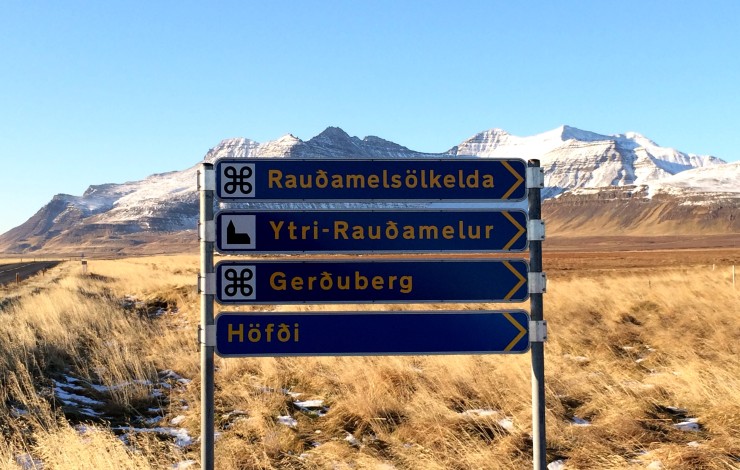
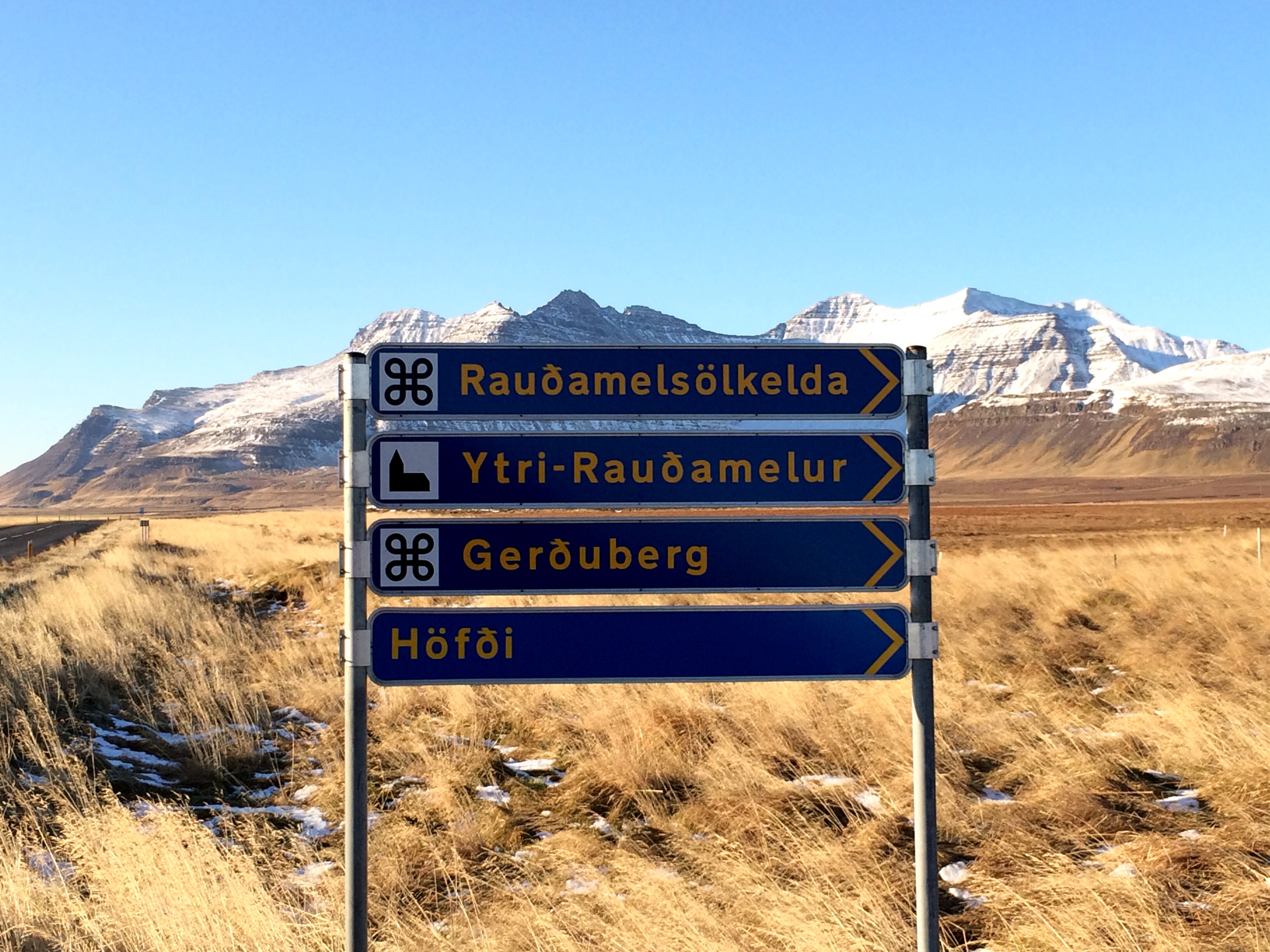
Probably the most important sign you'll come across is the "place of interest" sign. This is the sign you need to look for because it means there's an adventure waiting to happen. The sign sometimes just has the symbol and other times has the symbol and the name of the place. The strange loopy symbol at the first and third sign below is the "place of interest" symbol.

Icelandic road signs near Höfði
Signs also indicate when you enter and exit town limits. I thought these signs were clever.

Hofsos town sign

leaving town limits sign
Here's a great infographic about driving in Iceland by Blue Car Rental. We didn't use this company, but they do have a a great graphic!

driving in Iceland
Gravel & F Road Driving
The gravel roads are marked by a sign that says "Malbik Endar", which translates to "asphalt ends". Most of the gravel roads have a speed limit of 80 kph (about 50 mph), but I never felt safe going that fast. Icelanders would fly down the gravel roads, but I thought that was crazy! Be mindful of your speed on the gravel areas. There are many warnings about speeding on the gravel portions. I say heed the advice - I found the gravel to be quite tricky to drive on. As long as I slowed down to about 50 kph (about 30 mph), I was fine. Also, be sure to stay on the roads. Off-road driving is strictly forbidden in many areas and is often marked with a sign.
F Roads are roads that typically require a 4WD vehicle or "super Jeep". Our van rental company would not allow us to drive on F Roads, or it would void our insurance. Many F Roads were closed in the winter anyway, though. These roads are really the "backroads" routes. They often marked with a sign that read "Illfaer Vegur", or "difficult road".

Road signs, including the coveted "place of interest" symbol and the dreaded F Road.
Blindhæd
This was a very straight-forward sign. In areas where you come to the top of a hill "blinded" to what's coming up the other side, you often saw a sign that said "blindhæd" or "blind rise". This peak of hill often had a signpost in the middle of the road and the lanes split apart a bit to encourage you to stay to the far right of your lane.

snowy mountains are pretty prevalent in Iceland
Bridges
Do not ever cross a body of water without a bridge. I feel like that should be a no-brainer, but Icelanders seem to be very concerned with visitors attempting this. When you do come upon a bridge, it is often a one-lane bridge. It is usually accompanied with a side that says "Eimbreid Brú", which means "single-width bridge". In this instance, you are expected to let the first person to approach the bridge go first...or communicate with flipping your high beams. We luckily never had any problems with single lane bridge communication. Just remember not to drive so fast that you can't stop at the bridge if needed, and ideally, you should slow down!

bridge near Dettifoss
Fuel Stations
We lucked out and found a discount card for Orkan gas station in our glove box...score! Since we had the card, we often tried to stop at an Orkan along the road. However, the N1 fuel station was much more prevalent throughout the country. The fuel stations usually opened around 9:00 a.m. or so, but the pumps were self-service with outside payment options for debit or credit cards. The payment process on these self-serve machines was a bit strange. As long as you choose the appropriate language, you should get the hang of it. However, if you accidentally choose Icelandic...good luck. We did that many times. Many many many times. But it still worked out.

fuel station payment machine
The stations typically closed around 23:30 (11:30 p.m.). They certainly were helpful for us for a number of reasons - fuel (the van was diesel), snacks, bathrooms, and directions. Compared to the U.S., it seemed like the fuel stations were a central hub in the town. They basically combined the idea of what Americans know as a gas station and a fast food restaurant into one. The station attendants are very knowledgeable about road conditions, which routes to take, weather, etc. The majority of them were very nice (we found some grumpy ones) when we asked for advice for our travels. You should certainly ask them information about the best route to take and the weather - there was an instance where we weren't sure we could get to Höfn due to icy roads, and the attendants gladly explained which route to take instead. We also were able to fill up our water tank in the van for free! We were turned away at a couple stations, but most stations gladly let us fill the tank.
Icelandic Farms
We noticed that most of the farms along the Ring Road had a sign marking the home address at the beginning of their driveway. Often times, the sign and driveway was all that you could see! It seems like Icelanders liked their privacy, because their houses were typically quite a ways off the Ring Road and sometimes even hidden behind some land formation like a hill, some boulders, or nestled in lava fields. I think the houses are marked by family name instead of by number, but I can't find anything online to corroborate that assumption. We just didn't see any house numbers like we have here in the United States, only what seemed like names. Sometimes when there were several houses, the signs would state "Name I", "Name II", etc., which I assumed meant multiple generations lived next to each other. Anyone know if this is true?

I believe this was a family sign.
Weather Forecast/Gas Forecast/Roads Conditions Websites
Iceland does a fantastic job keeping you updated about weather, road conditions, and (currently with Bardarbunga erupting) sulfur dioxide forecasts.
The official Icelandic weather website was crucial to us knowing what was happening weather-wise. Iceland's weather can change within 10 minutes, so it's nice to have up-to-date weather all the time. This helped us know the temperature (high/low), the precipitation amount, the type of precipitation, the wind forecast (wind in Iceland is some of the worst in the world...literally), storms, etc.
Bardarbunga was really starting to create some nasty air quality in Iceland while we were there. The gas forecast portion of the weather website was crucial in helping us where the wind was blowing the sulfur dioxide and at what levels they were. Since we were sleeping in a vehicle that we couldn't exactly seal off from gas as well as hiking around outside, we just needed to be careful. Gas levels were so bad in some parts of the country that they had to cancel school. From what we understood, the sulfur dioxide wouldn't kill you, but it would certainly cause breathing difficulties for the elderly, those with asthma, etc. But at high enough levels, it could cause breathing difficulties in healthy individuals, too.
I can't tell you how many times per day we checked the road conditions website. It's updated about every 15 minutes. Since the weather can change so quickly, it's great to have up-to-date information on the roads. The website had a legend describing each road's condition - we stuck to roads colored green, yellow, light blue, and sometimes dark blue. Happy Campers also encouraged us to stick to those roads, as well. Since I feel comfortable driving in snow, I didn't often feel overly nervous about the roads. This website was such a lifesaver for us. The fuel station attendants could pull up the website for you if you stopped to ask them. Also, a little tidbit of information: the Ring Road is often snowy and in the dark blue/white (or worse) zone in the morning. The consensus we got from locals is that the authorities typically have the road cleared by 10:00 a.m. if the snow isn't too bad. If it's in the middle of a snowstorm? They wait until it's over and then clear it. And holy guacamole, are those snow plows huge!

Here's the legend for the road conditions map.
Wind & Weather in the North & South
Happy Campers told us to always park facing into the wind. This way, the wind would move smoothly around the vehicle instead of crashing against its wide side. You also want to park facing into the wind so that you don't damage the car doors when you open them. They have had many instances where car doors were damaged because of wind gusts. On a night that we had a wind advisory (minimum of 80 kph or 50 mph), we parked the van facing into the wind. We were kept awake all night because the wind knocked the van back and forth, and I swear it tipped it up on two wheels a couple times! Overall, just park facing into the wind and drive carefully in windy conditions. The majority of the trip for us wasn't really too windy - only the last couple days while on the southeastern and southern parts of the country. 🙂
We got to Iceland on the second day of their winter season. When we were in the northern part of the country, it was typically about -1 to 8 degrees Celsius (30-45 degrees Fahrenheit), with the lowest temperature we saw at night around -7 degrees Celsius (around 20 degrees Fahrenheit). The southern part of the country was typically around 4 to 13 degrees Celsius (around 40-55 degrees Fahrenheit).
The north had more snow. The deepest snow we saw was probably around 127 mm (about 5 in), but that was while hiking. The roads did occasionally have snow or ice on them, but it was never that bad. We did get to relax in the Mývatn Nature Baths surrounded by snow and frigid temperatures...and it was glorious since the water was so hot! We saw no snow in the southern part of the country, but there was a decent amount of rain. Regardless of weather, we still had an incredible adventure!

Hverfjall, the tephra crater that we hiked. This is where we saw about 5 inches of snow.
Clockwise or Counter-clockwise?
This is something we didn't even consider while planning the trip but thankfully lucked out on choosing what we felt in the end was the best choice. We'll talk more about our itinerary in a later post, but I think it's worth mentioning here as well. We were so very thankful that we chose to drive clockwise around the island. Why did we choose this route? We wanted to get through the northern part of the country, where we knew the weather could be a bit sketchy at times, early in the trip so we weren't rushing back to our flight. Why were we thankful that we made this choice? Simply put, we were on the inside of the road! We quickly found that Iceland lacks guardrails...in almost every area. They have very few in the country. As a chef in Akureyri put it "We drive big vehicles. If our big vehicles hit a guardrail, we'll just flip over it. So no matter what, if you go off the road with or without a guardrail, you will wreck and probably die." Erm. Okay? Not that I want to scare you...but I do want to prepare you! I will say that driving in Iceland has certainly given me more confidence in my driving and helped me explore the horizons in terms of driving conditions. 😉
But back to the clockwise trip...we were very thankful while driving along the most dramatically gorgeous cliff-sides along the sea that we were on the inside road. There was even one part of the trip when we went north to Siglufjörður and encountered rain and some of the worst high winds I've ever seen in my life...while driving along a cliff with giant waves crashing hundreds of feet below. Yeah, that day I was SO VERY thankful to be driving clockwise. So keep that in mind while planning your trip! 🙂

This was the one quick pitiful shot we got on our way to Siglufjörður, and we managed to get a shot of one of the few places with a "guardrail".

beautiful moon on our trip to Höfn
4 Comments
darwinontherocks
We did it anti-clockwise and I agree, during winter it must be a terrible and frightening choice 😀
vincsiow
Great blog! Do you think it’s dangerous to do the Ring Road in winter then?
Justin & Kiley
I think it depends on when you go and how comfortable you are with driving in snow and ice. Early winter wasn’t bad at all. We only encountered at most probably about 4-5 inches in the Mývatn
area, and the roads were mostly clear. The government is very good at keeping the main roads drivable. However, unlike the United States, if there is a snowstorm in the morning that won’t be over until 11 a.m., they wait until it’s done to plow, which obviously could pose problems with a tight schedule. I don’t know that I would go later in the winter simply because a lot of places may be inaccessible because of weather, which might be disappointing. We highly suggest going in the early winter (their winter officially starts October 25 if I recall), because this is a great time – it’s the off season so prices are much cheaper, ice caves are formed and ready for exploring, and you get to see the simple magic of a partially frozen landscape in the north and the beauty of a somewhat rainy and colorful south. We plan on doing a 2 week campervan road trip in the summer, though, so we can experience it all again in warm weather! There are so many awesome things in both winter and summer!
vincsiow
Thank you for the information Justin and Kiley! I’ll be reaching on the 31 Oct and officially leaving for the Ring Road at the 2 Nov – 11. Hopefully that will be ok!
I have read that the road from Egilstaddir to Myvatn can get a bit dodgy in winter!